
Two modules open on the same desk during a single evening session.
The instinct is to finish things. Do all the thermodynamics, then all the kinetics. Work through chapter four until it is solid, then start chapter five. It feels orderly, it produces a visible sense of mastery, and it prepares you badly for a paper in which the questions do not announce which chapter they belong to.
Interleaving means deliberately mixing: two or three topics in one session, rotated rather than completed. It performs worse during practice and better on the test, which is exactly the pattern that makes it hard to adopt, since the only feedback available while you are doing it is the feedback that says it is going badly.
What blocking actually trains
When twenty problems in a row are all the same type, you solve the first one properly and then run the same procedure nineteen times. The hardest step, which is working out what kind of problem you are looking at, is answered by the page heading rather than by you. Come the exam, the heading is gone, and the skill that was never practised is the one being tested.
The same applies to essay subjects. Reading a whole week's worth of material on one theorist keeps that theorist's vocabulary in working memory, and everything feels connected. The exam question that asks you to compare two theorists arrives without that support, and the connections have to be made from cold.
Blocking also inflates confidence. Fluency within a block is a poor predictor of performance outside it, and a session that ends with a run of correct answers leaves a memory of competence that was partly supplied by the ordering of the questions.

A mechanical timer used to end a block, which is easier to obey than a clock on a phone.
How to mix without making a mess
Pick two subjects for a two hour evening, not five. The point is contrast, not chaos, and more than three rotations in a sitting spends all the time on switching.
Use blocks of twenty five to thirty minutes and switch on the timer, whether or not the current problem is finished. Leaving something unfinished is uncomfortable and useful: you return to it later having had to reload the context, which is itself the retrieval you are trying to practise.
Choose subjects that are genuinely different in shape. Statistics and constitutional law mix well. Two closely related quantitative modules mix badly, because the procedures start bleeding into each other and you end up applying the wrong formula for reasons that have nothing to do with memory.
Within a subject, mix problem types rather than working a set of identical ones. If the textbook groups its exercises by type, take three from each of four sections and shuffle them, then answer without looking at which section each came from. The first question you have to ask is what kind of problem this is, which is the whole point.
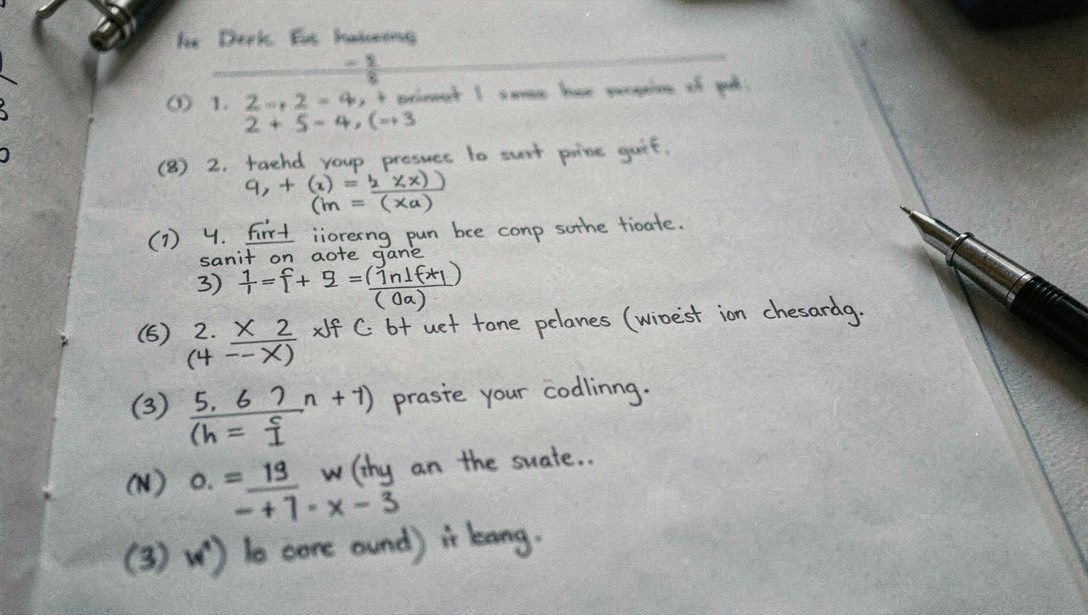
A worksheet assembled by hand from four different sections of the same textbook.
What it feels like, and why that matters
It feels like going backwards. You will get more wrong, you will lose your thread, and you will finish a session with a lower proportion of correct answers than a blocked session would have produced. That discomfort is the mechanism working, and knowing this in advance is the difference between sticking with it for a fortnight and dropping it after two evenings.
Keep a score so the judgement is not left to feeling. Note the proportion correct each session. Over three or four weeks the mixed sessions climb, and the climb is real rather than supplied by the ordering. If it does not climb at all after a month, the mixing is probably too aggressive and the sessions should drop to two topics with longer blocks.
A mixed session is set up correctly when:
- Two subjects, rotated in blocks of about half an hour, switched on the timer.
- The subjects are different in kind, not two versions of the same skill.
- Problems inside each block come from more than one section, shuffled.
- You expect to score worse than in a blocked session and record the score anyway.
The limits are important and often left out. Interleaving is for material you already understand. Meeting a topic for the first time in a mixed session is simply confusing: first exposure needs a block long enough to build the model, and only then does mixing sharpen it. The sequence is learn in blocks, consolidate mixed.
It is also poorly suited to long single tasks. An essay plan, a laboratory write up or a four hour design exercise cannot be chopped into half hour rotations without losing more to context switching than the method returns. Reserve mixing for problem sets, short answer practice and the card pack built along the lines of flashcards that ask harder questions, and give the long tasks their own uninterrupted slots when you build a revision timetable that holds after week two.
One last practical note. Mixing works best when the material has been converted into something answerable, which is the argument made in the one page summary, built while the lecture is fresh. A shuffled pile of raw lecture notes is not a mixed practice session, it is a shuffled pile of raw lecture notes.