
A carrel at the end of an evening session, with the stack already reduced to the two topics still being worked.
The final days have their own logic, and it is not the logic of the rest of the revision period. Learning new material takes repeated exposure across weeks; there are no weeks left. What can still be improved in three days is retrieval speed, answer structure, and the number of small decisions you will have to make in the hall.
This is also the stretch where the most damage gets done. Panic reading, all night sessions and a first look at a topic that was skipped in February cost more than they return, and they cost it on the two days when the return has to be immediate.
Three days out: consolidate, do not expand
Work from the summaries, not the source. If you built one sheet per topic in the manner of the one page summary, built while the lecture is fresh, this is the day they earn their cost. Take each sheet, cover it, reproduce it on blank paper, then compare. Twenty minutes a topic, and the output is a short list of what is still missing.
Keep the list short on purpose. Three or four genuinely weak points per module is a workable target for the remaining time. A list of fourteen is not a plan, it is a description of a term that did not go well, and trying to close all fourteen in two days closes none of them.
Do one timed question per module, not a full paper. The purpose now is to keep the writing muscle warm and confirm the timing plan, not to gather new diagnostic information you have no time to act on. The full attempt belonged a month ago, under the conditions set out in past papers, timed and marked honestly.
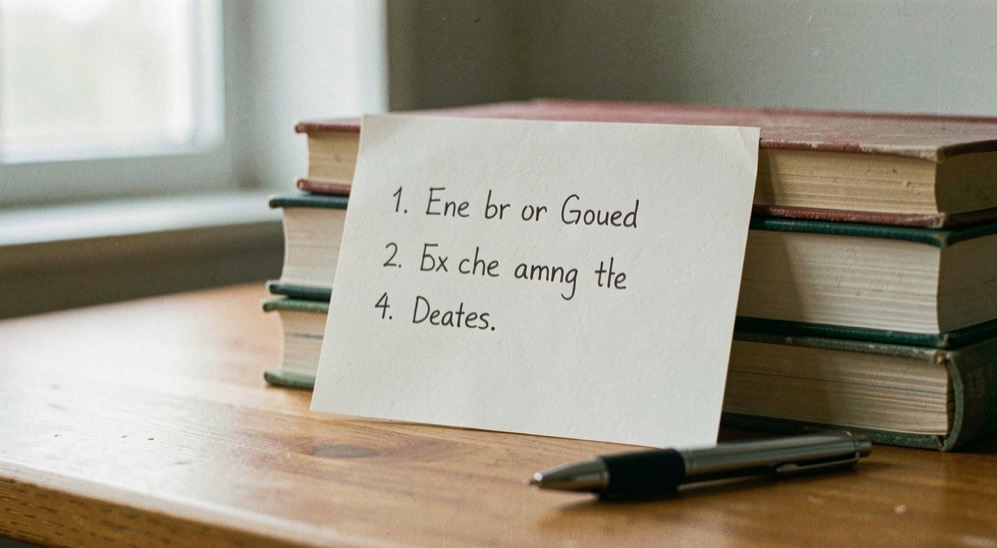
The weak point list kept to four lines on one card, which is what makes it usable on the last morning.
Two days out: rehearse the opening
Most of the anxiety in an exam is concentrated in the first ten minutes, and most of it is procedural rather than intellectual. Decide now, in writing, what those minutes contain: how long you spend reading, which order you answer in, how many minutes each question gets, what you do if the first question you turn to is one you cannot see an answer to.
Rehearse it. Take a paper, set a timer for ten minutes, and do only the opening: read everything, mark the questions you will take, write the minute budget in the margin, and start the plan for the first answer. Then stop. Doing that three times makes the opening automatic, and an automatic opening is the difference between starting to write at minute six and starting at minute nineteen.
Deal with the logistics on this day rather than the next. Find out the room, the start time and the journey, and check the rules on what may be brought in. Put the calculator, the pens, the identity card and the water bottle in a bag tonight. Every one of these is trivial and every one of them is capable of ruining a morning if it is discovered at eight the next day.
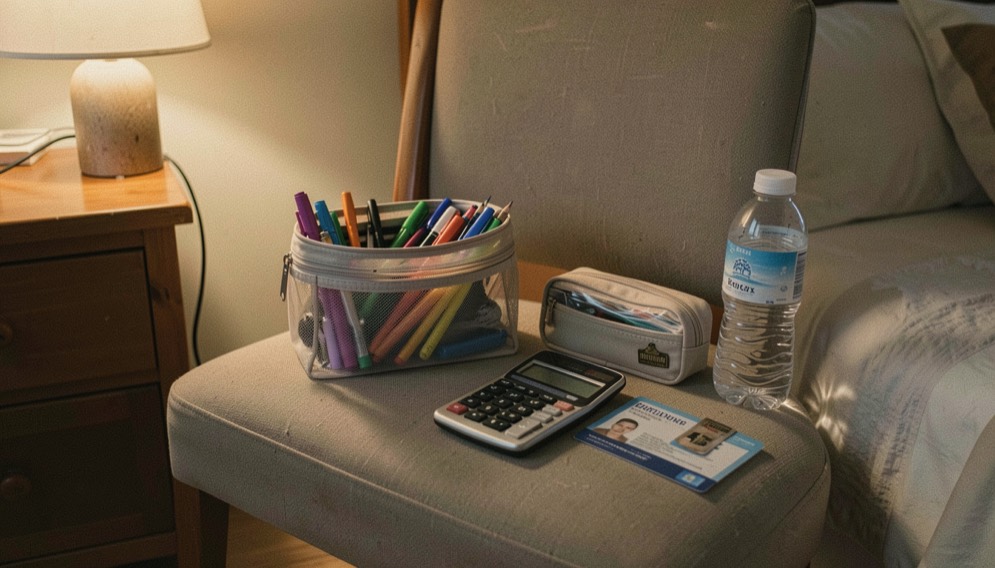
Everything laid out the night before, so the morning contains no decisions.
The day before, and the night
A short morning session, then stop. Two or three hours of light retrieval, working through the weak point card and the cards you keep failing, is enough. The afternoon is deliberately not revision. Walk, cook, see somebody, sleep early.
This is not a comfort measure. A short night costs more the following morning than any topic gained the previous evening, and the loss falls precisely on retrieval and on working memory, which are the two faculties the paper will be testing. The mechanics of moving a sleep schedule are covered in sleep and the nine in the morning lecture, and moving it takes days rather than hours, which is why the work belongs earlier in the week.
Across the final days, hold to four decisions:
- Nothing new is opened. Weak points are closed from existing summaries or left.
- The opening of the paper is written down and rehearsed until it needs no thought.
- The bag is packed and the route is known the night before, not the morning of.
- The evening before is not a revision session, and the night is a full one.
Now the limit, stated plainly, because a rule with no exception invites people to ignore the whole page. If a topic carries a large share of the marks and you have genuinely never covered it, three days is not nothing. You can reach a functional level: the core definitions, one worked example, the standard argument and its main objection. That is enough for a pass on a question rather than a blank, and it is worth the afternoon. What does not work is attempting that for four topics at once, or attempting it at midnight before a nine o'clock paper.
The other limit is that this stretch cannot repair a term. Three good days on top of eight weak weeks produce a better paper than three bad days would, and no more than that. The work that decides the grade happened in October, which is an unhelpful thing to read the night before an exam and a useful thing to remember when building a revision timetable that holds after week two for the term after this one.