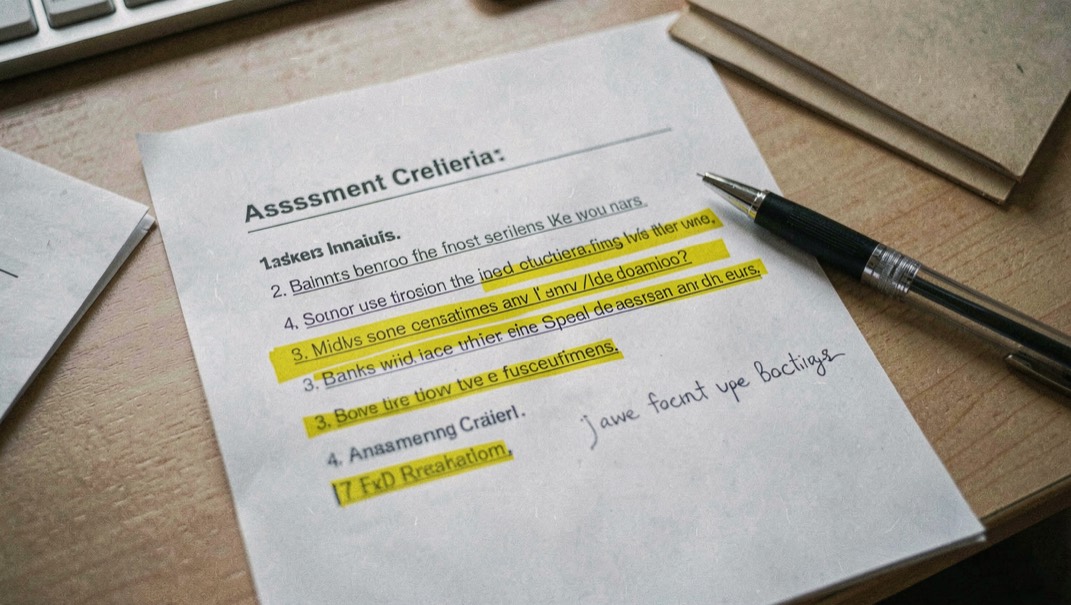
A criteria sheet marked up in advance, with the phrases that describe the top band highlighted.
Somewhere on the module page, usually in a document nobody opens, sits the description of what earns each band of marks. It is written in dry institutional prose and it is the single most useful document attached to the course, because it describes the object you are being asked to produce.
The gap between what students think is being marked and what is actually being marked is wide and consistent. Students tend to believe that marks reward the amount of correct material recalled. Criteria almost always reward something else: selection, structure, the use of evidence, and the presence of a position that is argued rather than asserted.
What the wording is telling you
Read the top band and the band below it side by side, and look at what changes between them. That difference is the whole message. Very often the lower band says something like "describes the main theories accurately" while the higher band says "evaluates competing explanations and justifies a preference". Both require the same knowledge. Only one of them requires you to do something with it.
Command words in the question do the same job at the level of a single answer. Describe, explain, compare, evaluate, justify and discuss are not decorative verbs. An explain question that receives a description will lose marks even if every sentence is true, and this is the most common way a well prepared candidate loses a grade on a question they knew.
Weightings are equally informative. When a scheme allocates a quarter of the marks to the use of sources or to the interpretation of results, an answer with no sources or no interpretation has capped itself before it started, no matter how strong the rest is.
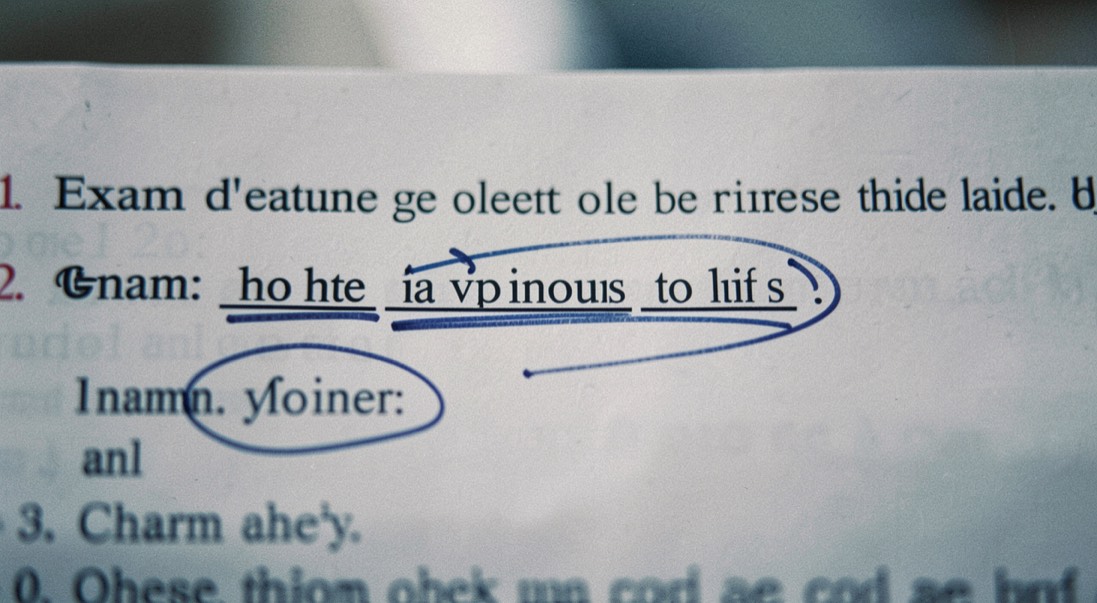
The command word underlined before anything is written, which takes four seconds and changes the answer.
Using it while you revise, not after
Print the criteria and keep them with the module. Then use them as a template for practice, which is where the real gain is. Write a plan for a past question, ten minutes, then read your plan against the top band and ask whether it would satisfy each clause. Usually two clauses are missing, and they are the same two clauses every time, which is exactly the sort of personal pattern that is worth knowing in October rather than June.
Mark other people's work if you can get it. Departments sometimes publish sample answers with commentary; a study group can swap plans. Marking somebody else against a scheme is a much faster way to internalise it than reading it, because it forces you to apply the wording rather than agree with it. It also makes the self marking described in past papers, timed and marked honestly considerably less generous.
Where examiners publish reports, read them. They are usually a page or two and they are startlingly direct: candidates ignored the second half of the question, few gave a worked numerical example, most answers to question three were narrative rather than analytical. That is a description of the mistakes made by the people who sat in your chair last year.
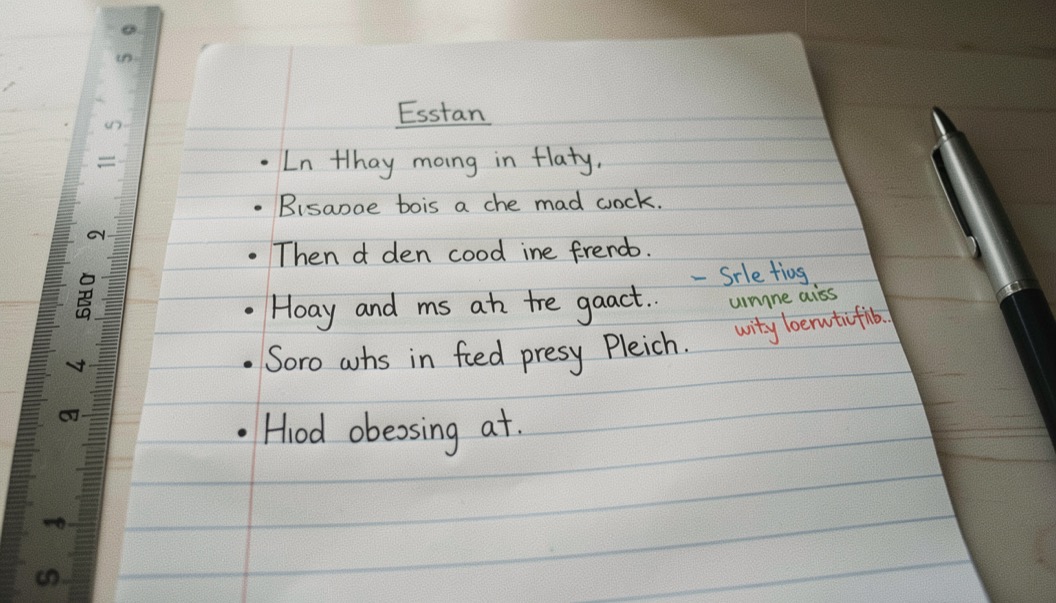
A ten minute plan annotated afterwards against the published criteria.
In the hall
The scheme is not in front of you, so what you carry in is a shape. Before writing, underline the command word and any qualifier attached to it, and note the mark allocation. Four marks is a short paragraph. Twenty marks is an argued answer with a position, evidence and at least one counter case.
Answer the question actually asked. Under pressure there is a strong pull towards the adjacent question you prepared for, and an answer that is excellent about something slightly different scores poorly. Rereading the question after finishing costs thirty seconds and catches this.
Before an answer is written, three marks go on the paper:
- The command word underlined, so the demand is fixed before the content arrives.
- The mark allocation noted, which sets the length and the depth.
- A plan of the points in order, with the strongest one placed where it will be read.
Two limits are worth being honest about. Not every department publishes anything useful. Some schemes are generic across a whole faculty and say little more than that better answers are better, in which case the tutor's feedback on returned coursework is the substitute, and it is a good one, because it is the same person applying the same standard to your own work.
The second limit is that a scheme describes the shape of a good answer and cannot supply the content. Writing something structurally perfect and factually thin is a real failure mode, and it happens to people who have read the criteria carefully and revised the material lightly. The criteria tell you how the material must be deployed. Getting the material into your head in the first place is the job of the sections on note taking and revision methods, and neither can be skipped by knowing what an examiner wants.