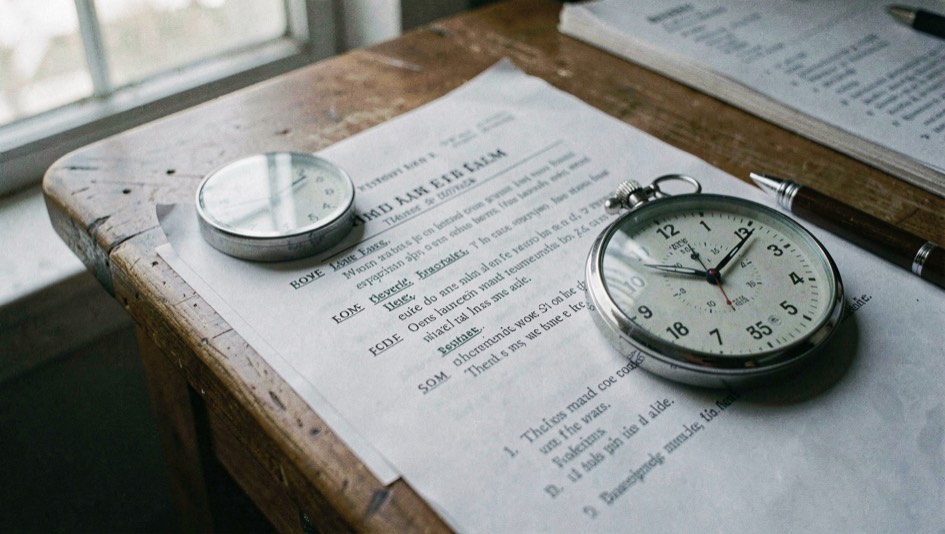
A paper started with the stopwatch already running, which is the only condition under which the attempt tells you anything.
Everyone does past papers and most people do them wrongly. The usual version happens on a Sunday afternoon: the paper is open, the notes are open, a question is read, the notes are consulted, an answer is assembled over forty minutes, and the whole thing is scored as done. Nothing about that resembles the exam, and nothing about it measures readiness.
The exam tests three things at once: whether you know the material, whether you can retrieve it without prompts, and whether you can produce a complete answer inside a fixed number of minutes. Only the first is being trained by an open book attempt, and it is the one most likely to be adequate already.
Setting up an attempt that means something
Clear the desk. Paper, pen, calculator if the rubric allows one, water. Nothing else. No notes, no phone within reach, no tab open with the module page. Set the clock for the real duration, and if the paper is three hours, do three hours.
Take the reading time seriously, because it is a scheduling decision and not a formality. Five minutes at the start to read every question, mark the ones you can do confidently, and write a rough minute budget next to each. On a three hour paper with four equally weighted questions that is forty minutes each with twenty spare, and knowing the number before you start is what stops the first question eating an hour.
Then obey the budget. When the forty minutes are gone, stop, even mid sentence, and move on. The most common way to lose marks in a paper you knew is to write a superb answer to question one and two paragraphs for question four. Two thirds of the marks on a question you have barely started are much easier to reach than the last tenth of a question already answered well.

A hall clock seen from the back row, which is the view most candidates work from.
Marking your own script
The attempt is worth roughly half of what the marking is worth, and the marking is the part almost everyone skips. Leave a gap, ideally overnight, then sit down with the mark scheme and a red pen and mark the script as though it belonged to a stranger.
Award marks only for what is written on the paper. Not for what you meant, not for what you would have added given another five minutes, not for the step you did in your head. An examiner reads only the script, and the habit of generous self marking is the reason so many people are surprised in August. Reading the criteria properly before the next attempt is covered in reading the mark scheme before you answer.
Then classify every lost mark into one of four causes: I did not know it, I knew it and did not retrieve it, I knew it and ran out of time, or I answered a different question from the one asked. The four causes lead to four completely different remedies, and treating all lost marks as a signal to revise more is why so much revision goes into topics that were never the problem.
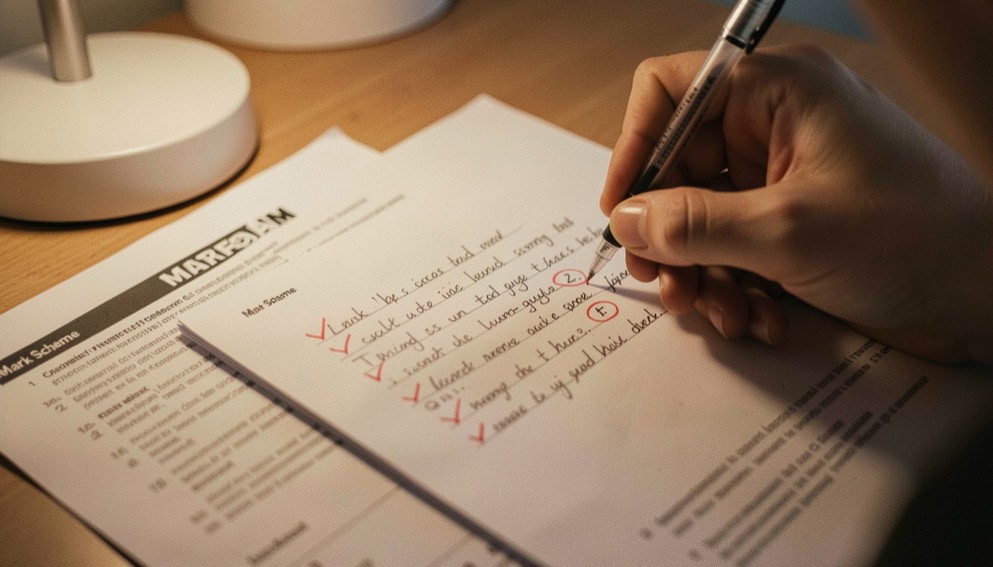
A script being marked against the published criteria the morning after the attempt.
How many papers, and when
Full papers under full conditions are expensive: three hours plus an hour of marking, so half a day each. Three or four per module across the revision period is realistic and enough, provided they are spaced rather than clustered in the final week.
Between the full attempts, use single questions. Forty minutes, one question, closed book, marked the same evening. A single question costs an hour and trains the same three skills at smaller scale, which means you can do a dozen of them in the time three full papers would take. Plans alone are cheaper still: ten minutes producing the structure of an answer, then compared against the criteria, which trains the part of essay writing where most marks are decided.
Sequence matters. The first full paper should come early enough that its findings can change the plan, which usually means a month out rather than a week. A paper sat two days before the exam produces information you no longer have time to act on, and the last days are better spent as described in the last three days before an exam.
An attempt counts only if all four hold:
- Full duration on a clock, nothing on the desk that will not be in the hall.
- A minute budget written on the paper in the first five minutes and obeyed.
- Marked against the published criteria, awarding marks only for what is written.
- Every lost mark classified as knowledge, retrieval, timing or misreading.
Two limits, both worth knowing before you build a plan around this. Past papers only test the syllabus that produced them, and syllabuses change. A paper from four years ago may cover material that has been dropped and miss a topic added last year, so check the current specification before concluding that a topic is unimportant because it has not appeared recently.
The second limit is that timed practice is a measuring instrument, not a teaching one. If the marking shows that half the lost marks came from material you never understood, the answer is not another paper. It is to go back to the notes and the worked examples, rebuild the topic, and only then measure again. Doing paper after paper on a foundation that is not there produces a very precise record of the same failure, which is discouraging and expensive. The rebuilding itself is faster if the material was converted rather than copied, which is the argument in rewriting notes is not revision.