
The end of an evening shift, at the hour when a nine o'clock start the next day becomes a scheduling problem.
Working during term is ordinary. It pays for things that have to be paid for, and it produces exactly the material a thin CV needs. The mistake is treating the hours as free time being converted into money, when they are study time, sleep or social contact being converted into money, and the choice of which one is being spent is usually made by the rota rather than by you.
Where the ceiling sits
A full time course is designed as a full time occupation. Contact hours look light and are only a fraction of the intended workload, with the rest expected as reading, problem sets and coursework. Add fifteen or twenty paid hours and the total is a long working week, which is possible but leaves nothing for the weeks when three deadlines coincide.
Around ten to twelve hours a week is where most people can work without visible damage, and past fifteen the effects start showing up in the parts of the course that are easiest to postpone: the reading, the problem sets attempted properly rather than copied, the practice papers. Note that these are also the parts that decide the grade, which is why the damage appears late and appears all at once.
Do the arithmetic before agreeing to a rota, not after. Write the teaching, the shifts and a realistic study block on the same grid, in the manner of a revision timetable that holds after week two. If the grid has no empty squares at all, the plan has already failed and the only question is which commitment will absorb the failure.
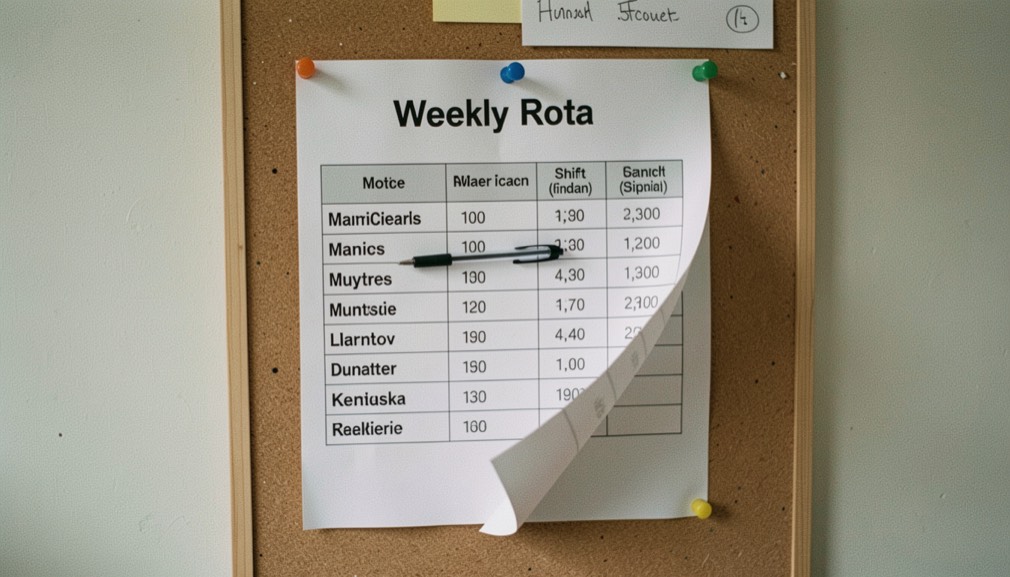
A rota posted for the coming week, which is the notice period most term time jobs actually give.
Which shifts cost least
The number of hours matters less than where they land. A shift that finishes at eleven at night before a nine o'clock lecture costs the lecture as well as the sleep, and it does so every week it repeats. A Saturday daytime shift of eight hours costs a Saturday and almost nothing else.
Predictability is the second variable and it is underrated. A fixed rota can be planned around; a rota posted on Thursday for the following week cannot, and it silently prevents you from committing study blocks in advance because you do not know when you are free. Two identical jobs on paper can differ enormously on this point, and it is worth asking about at the interview.
Then there is the shape of the work itself. Jobs on site, where the commute is five minutes, return an hour a day compared with jobs across town. Jobs with quiet periods, such as some reception, invigilation and library roles, sometimes allow reading during the shift, which changes the arithmetic completely. Jobs that are physically exhausting cost more than their hours, because the evening after is not usable.
Term time jobs advertised by the institution are usually built around teaching patterns and tend to be the least damaging, which is worth checking before looking anywhere else.

The walk back after a late finish, which is part of the cost of the shift and rarely counted as such.
Protecting the term when the rota moves
Decide in advance what is not available, and say it once, clearly, when you start. Two or three fixed blocks that are never open for shifts, chosen to sit before your heaviest teaching or on the evening you always study, are far easier to defend as a standing arrangement than as a series of individual refusals.
Give notice for the assessment periods early. A manager told in week two that you are unavailable for a fortnight in April will usually plan around it; the same request made in week ten of the second term will not. Most term time employers have seen this before and expect it.
Watch for the drift. Extra shifts are offered when someone is ill, and saying yes is easy because a single shift is small and the money is immediate. Ten hours becomes fourteen over a month without any decision having been taken. A weekly check against the number you set is the only reliable defence, and it belongs in the same ten minutes as the update to a budget sheet that survives term one.
Set the terms of the job rather than accepting them week by week:
- Pick an hours ceiling before you start and check the actual total weekly.
- Prefer fixed, predictable shifts over slightly better paid unpredictable ones.
- Refuse late finishes before early teaching as a standing rule, not case by case.
- Give notice for assessment periods weeks ahead, in writing.
The limit of all this is obvious and worth stating anyway: for many people the hours are not optional, and advice to work less is not advice at all. Where that is the case, the levers are the shape rather than the quantity. Move hours to weekends and daytimes, cut the commute, look for a role with quiet periods, and check whether every grant, bursary and hardship fund available has actually been applied for, because unclaimed institutional money is common and pays considerably better than an extra shift.
The other thing worth doing is keeping a record while you work. Dates, responsibilities, anything you were trusted with, any figure you can attach to it. A term of shifts written down as it happens becomes a usable section of a first CV when the experience column is thin, and reconstructing it eighteen months later from memory produces a much weaker page. The same record is what makes the examples in placement interviews: the questions that come back specific rather than vague.